Lammas/Lughnasadh 2025
- Natalie Wyatt
- Jul 30, 2025
- 7 min read

Updated: Aug 22, 2025
As the golden hush of summer begins to dim, August steps forward like a threshold. On the first, Lammas (LAM-uhs) or Lughnasadh (loo-na-sah)—marks the beginning of the harvest, where warmth turns to reverence and sunlit abundance prepares to be gathered.
The Wheel of the Year brings us to the first of 3 pagan harvest festivals. Followed by Mabon and Samhain (sah-win). I myself though happen to follow a Norse pagan path and this is what I have in my notes from throughout the years. Now your season and how you celebrate may differ from what I have here and that's okay. No two paths are going to be identical and no singular person's path is more "right" than the others. These silly little blog posts and videos is for myself to document my personal path and hopefully help any baby witches/pagans that may have questions or need a little help.
This date marks the turning of the wheel once again. It actually depicts that we are halfway through the year or halfway between the Summer Solstice and Autumn Equinox.
This holiday signifies the first harvest of the year, mostly of the grains. The word Lammas is an in scripted word, which translates to, 'loaf mass', in the modern language. Freyfest, Freysblot, Lammas and Lughnasadh are just a few names that were given to this time of the year. The traditional custom of the holiday starts when we begin to gather the fruits of the labors from the hard work. As the months proceed, we collect the harvested food, to be used in the upcoming winter seasons and wait for the blissful cooler months.
On this day, the followers bake fresh loaves of bread in different shapes, especially in the shape of a phallus, to honor the Norse god, Frey. The followers then symbolically sacrifice the bread and engage in a large meal or a feast, prepared for this day, as a sacramental custom.
It is also celebrated to give honors to the ancestors and the other Norse gods. And, to show gratitude towards the abundance in our lives. It resonated with abundance, feasting and family.
Symbols of Lughnasadh
Colors: Yellow, orange, gold, green
Foods: Grapes, wine, beer, bread, grains, blackberries, pears, raspberries, black currants, corn
Stones: Citrine, peridot, carnelian, gold topaz, clear quartz, amber
Symbols: Corn dollies, wheat, bread, cauldron, corn, herbs, threshing tools (scythe, sickle, etc.…)
Flowers: Sunflowers
Oils: lime, cinnamon, sandalwood, clove and frankincense
History of Lughnasadh
Lughnasadh is named after Lugh, a prominent figure from Irish mythology. Because ancient Celtic people did not have written history, much of Irish mythology is interpreted through the writings of Romans and later on, Christian monks. The Roman emperor, Julius Caesar likened Lugh to the Roman deity Mercury and as such Lugh is considered a warrior and portrayed as the god of craftsmanship, including blacksmithing and wheel making.
One version of the origins of Lughnasadh is that Lugh wanted to throw a festival to honor his foster mother Tailtiu, who died of exhaustion from clearing the plains in Ireland for agriculture. The other origin story is that Lughnasadh was a celebration of Lugh’s marriage. The festival coincided with the first grain harvest of the growing season. Grains like wheat, barley, oats and corn were vital for surviving the long cold winters of the Northern Hemisphere. So it makes sense that the first harvest of grain was a cause for celebration, with or without the Irish Sun God. On August 1 grain would be harvested in the dawn hours and by evening it was baked into a loaf of bread to be shared by the community.
History of Freysblot
The name Lammas is taken from an Anglo-Saxon heathen festival which was forcibly Christianized. The name (from half-mass, "loaves festival") implies, it is a feast of thanksgiving for bread, symbolizing the first fruits of the harvest.
Heathens mark the holiday by baking a figure of the God Freyr in bread, and then symbolically sacrificing and eating it.
Again, no purely Heathen name has survived for this festival, which takes place at the beginning of August, as this was the time when the first fruits of harvest were brought to the church as gifts, since this was taken over from Heathen custom. In English and German tradition, the First Sheaf was often bound and blessed as an offering to Heathen deities or the spirits of the field at the beginning of harvest, just as the Last Sheaf was at its end. English folk custom also includes the decoration of wells and springs at this time.
In Heathenism today, the feast is especially thought of as holy to Freyr as a fertility God, Thor as a harvest God and his wife Sif, whose long golden hair can be seen in the rippling fields of ripe grain. The warriors who had gone off to fight at the end of planting season came back at this time, loaded with a summer's worth of plunder and ready to reap the crops that had ripened while they were gone. Loaf-Feast is the end of the summer's vacation, the beginning of a time of hard work which lasts through the next two or three months, while we prepare ourselves for the winter.
The harvest festival; giving thanks to Urda (Ertha) for her bounty. Often alms are given to the unfortunate at this time, or loaves in the shape of the fylfot (the Sun-wheel, which fell into regrettable disrepute during the dark times of the second World War when the symbol was perverted as a symbol of chaos and darkness). Interestingly, Lithasblot 1941 was allegedly the time when the magical lodges of England performed rituals to keep the Nazi forces from invading their country, which may have worked, since Hitler eventually abandoned plans to invade Great Britain. Lithasblot has long been associated with ceremonial magic and magical workings.
Lammas is the holiday of the first cutting of the grain, when John Barleycorn dies to feed us all. Every culture has a version of John Barleycorn, and in our cosmology it is Frey, who is mourned on this day for his sacrifice that we might live. Nerthus, his mother who cuts him down, is also honored; so is Gerda, his garden-goddess bride whose tears guide him back from Death. Another Lammas-associated goddess is Sif, whose golden hair is associated with the grain that Thor’s rains grew. Aegir may be celebrated as a brewer – as Frey is a beer god – and Njord may be hailed for the fish harvest that comes in. This is also an excellent time to honor Jord, the Earth Mother.
Ways to Celebrate
Bake bread from scratch and incorporate seasonal herbs from your garden (or supermarket)
Make fruit preserves
Make beer or enjoy an artisan beer (beer was very important in ancient times - in part because it was safer to drink than water).
Host a family and friends dinner and bonfire
Make Corn Dollies
BAKE BREAD
In ancient times Lughnasadh marked the beginning of the grain harvest. Grains like wheat, barley, oats and corn were vital for surviving the long cold winters of the Northern Hemisphere. So it makes sense that the first harvest of grain was a cause for celebration. On August 1, grain would be harvested in the dawn hours and by evening it was baked into a loaf of bread to be shared by the community.
GATHER FLOWERS
This simple activity is one of my favorites. Nothing makes an ordinary day feel special like having a bouquet of fresh seasonal flowers on my dining table or desk. Of course, flowers vary from place to place, but the most common blooms available in the Northern Hemisphere during Lughnasadh include sunflowers, black-eyed susan’s, poppies and gladiolas. If you don’t have access to your own fresh flowers, consider picking up an inexpensive bouquet at the grocery store.
MAKE SOME ARTS & CRAFTS
Lughnasadh is named for the Celtic Sun God, Lugh, who was the patron god of skilled craftsmen and blacksmiths, along with several other areas. Lughnasadh is a good time to make something special or try out a whole new skill, such as painting, weaving, pottery or woodworking.
MAKE A CORN DOLLY
Along the lines of arts and crafts, Corn Dollies are a fun activity to do with or without kids. A corn dolly is made from corn stalks and was a popular ancient tradition. Corn dollies were thought to embody the spirit of the harvest and give it a home during the long winter months. They would also be used as harvest decorations.
SET INTENTIONS
Lughnasadh is the midway point of the growing season (Beltane to Samhain) and midway between summer (Litha) and autumn (Mabon). It’s a good time to take a break and think about how your year has been and what you would like to accomplish through the rest of summer/the growing season. This could be literal (plants, crops, flowers) or more figurative such as new skills, habits or projects.
CELEBRATE THE GRAIN MOON
In keeping with the season of Lughnasadh, you can celebrate the full moon of August, known as the Grain Moon, Barley Moon, Sturgeon Moon and Dispute Moon. August was the time of the first harvest of the year, the Celtic and to celebrate the occasion with feasts and festivals. Today the Grain Moon is a time to celebrate all your work and progress during the year, knowing that you are also prepared for the months ahead
HOST A LUGHNASADH PARTY OR POTLUCK
Enjoy the late summer weather with a gathering of friends and family. Make some seasonal summer dishes and spend time with the people you care about.
Customs and Traditions
Fresh loaves of bread along with sacramental meal or feast is prepared on July 31st or on August 1st, to honor the Norse gods and the ancestors.
The bread is then sacrificed symbolically to start the sacramental feast. Modern followers also set up a simple altar with items that represent the season of the harvest. We use the autumn colors, green, brown, and yellow to craft items that represent the fertility of the season. We use candles (either scented with the fragrances of the season or non-scented) along with a sickle, woven baskets, grains, fresh fruits, veggies, honey, wine, flowers, corn and baked bread, to enhance the beauty of the sacramental feast.
Before sacrificing we pray for the blessings, abundance, and the gifts of the gods, that they possess and were bestowed upon. And pray to the gods to shower us with the utmost happiness, blessings, abundance and food, in the upcoming cooler months of the year.
Tarot spread
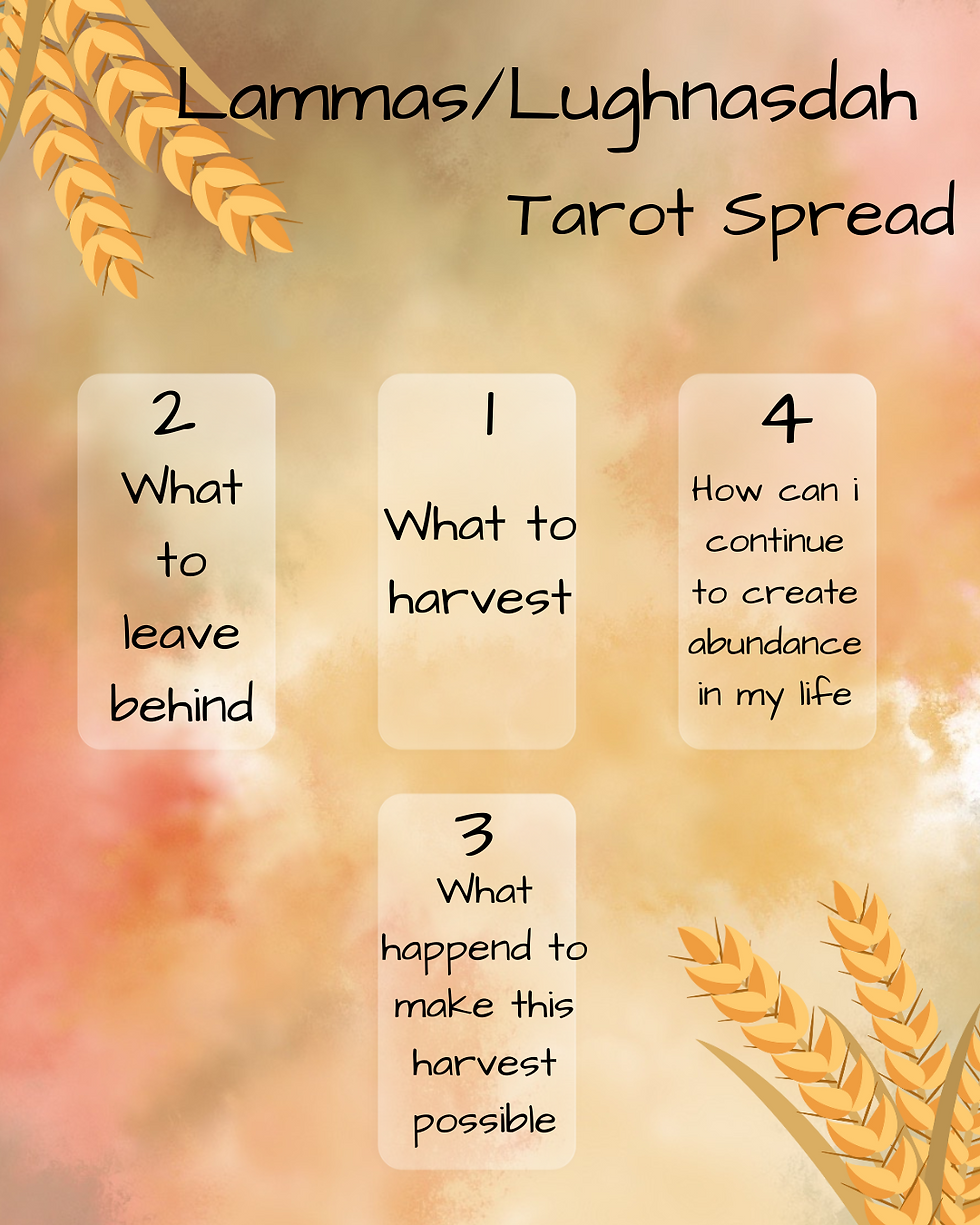
We stand now at the crossroads of light and labor. Lammas is not just the first harvest—it’s the proof that what we’ve nurtured can survive, and that what survives deserves gratitude. Whether your offerings are loaves of bread, whispered intentions, or small acts of care shared in quiet corners, this Sabbat asks you to honor what you’ve grown—alone, together, and in spite of everything.
As the sun begins its retreat, may your rituals carry warmth, your memories hold weight, and your magic meet you with open hands. Blessed be the hands that hold, the hearts that remember, and the spirits that refuse to wilt. May your harvest be sacred, your rest be earned, and your fire—however flickering—never be extinguished. Walk forward with your roots deep, your magic loud, and your joy defiant. This Lammas, we honor the becoming.
Signed, your favorite emotionally unstable folklore cryptid <3


Comments